Franchise wiki
The Six Million Dollar Man
The Six Million Dollar Man is a classic American science fiction and action television series that follows astronaut Steve Austin, who is rebuilt with advanced bionic implants after a catastrophic crash and becomes a secret government agent.
The Six Million Dollar Man is an iconic American science fiction and action television series that originally aired from 1973 to 1978. Based on Martin Caidin's 1972 novel "Cyborg", the franchise introduces a universe where advanced bionic technology allows for the creation of superhuman individuals. The series began with three pilot television films in 1973 before launching as a regular episodic series for five seasons from 1974 to 1978.
The premise centres on USAF Colonel Steve Austin, portrayed by Lee Majors, a former astronaut and test pilot who suffers a horrific crash in an experimental lifting body aircraft. To save his life, the U.S. government's Office of Scientific Intelligence (OSI) undertakes an experimental procedure, rebuilding him with bionic implants that cost an unprecedented six million dollars. These bionics replace his right arm, both legs, and left eye, granting him superhuman strength, speed (capable of running over 60 mph), and enhanced vision, including a 20:1 zoom lens and infrared capabilities. In exchange for his new life, Austin becomes a secret agent for the OSI, undertaking high-stakes missions. Key supporting characters include Oscar Goldman (Richard Anderson), the director of the OSI, and Dr. Rudy Wells (played by various actors, most notably Martin E. Brooks), the lead scientist behind the bionic technology.
The series is notable for its pioneering use of special effects, including distinctive slow-motion action sequences and electronic sound effects that accompanied Austin's bionic feats, which became instantly recognisable cultural touchstones. It significantly influenced popular culture's portrayal of the cyborg archetype and spawned the successful spin-off series The Bionic Woman, featuring Jaime Sommers. The enduring popularity of the characters led to several reunion television films in the decades following the original series' conclusion.
Sources
Generated with AI and grounded against these web sources via Google Search.
![The Six Million Dollar Man: The Complete Series [DVD]](https://m.media-amazon.com/images/I/71sirOjB4NL._SY679_.jpg)
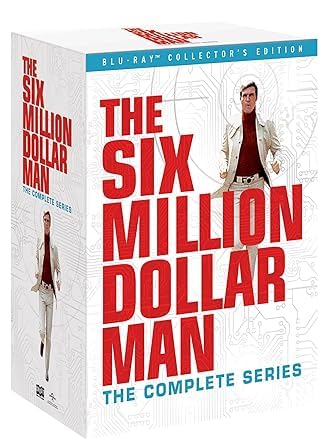

![The Six Million Dollar Man: The Complete Series - Amazon Exclusive Collector's Edition [Blu-ray]](https://m.media-amazon.com/images/I/8108Pci42CL._SY679_.jpg)

![The Bionic Woman: The Complete Series - Collector's Edition [Blu-ray]](https://m.media-amazon.com/images/I/81-Z6TvvHUL._SX522_.jpg)
![The Bionic Woman: The Complete Series [DVD]](https://m.media-amazon.com/images/I/71OSkTCm2iL._SY679_.jpg)

